Choosing pre roll equipment for business production is a different decision than picking a single machine for casual, small-scale use.
Volume targets, staffing, and consistency requirements all factor into it, and the equipment chosen at the outset tends to shape how easily a business can grow later on.
A setup that works fine for a handful of daily orders can fall apart entirely once demand climbs, while equipment built with scale in mind from the start avoids that ceiling altogether.
Looking at output capacity, staffing structure, and available system options gives a clearer picture of what actually matters when equipping a production line for business use.
Why Business Production Requires a Different Standard
Casual or small-batch rolling and business-level production operate under entirely different constraints. What works for one rarely holds up under the other.
Volume Changes the Equation Entirely
A business fulfilling regular wholesale or retail orders cannot rely on the same pace or consistency as an occasional small batch. Fill weight drift that goes unnoticed in a dozen units becomes a real quality control problem across several thousand.
Pre roll equipment for business production has to hold its consistency across long runs, not just short ones, which is a fundamentally different design requirement than equipment built for infrequent use.
This is also where labor cost becomes a real factor rather than a minor inconvenience. Every extra minute spent per unit multiplies across a full production day and a full production team.
Equipment that shaves seconds off a cycle at small scale saves hours at business scale, which is exactly why the equipment decision carries more weight once volume becomes a serious factor.
Consistency Becomes a Brand Issue, Not Just a Production Issue
For a business selling finished pre-rolls, every inconsistent unit that reaches a customer reflects on the business itself, not just on that single batch.
Premium pre rolled cones finish depends on more than the cone alone. It depends on a fill and closing process that produces the same result cycle after cycle, regardless of who is operating the machine that day.
Pre roll equipment for business production needs to remove operator-to-operator variation as much as possible, since that variation is what ultimately shows up in customer-facing quality.
Core Equipment Categories for Business Production
Business-level production is not built around a single machine. It runs on a coordinated set of equipment, each piece responsible for one stage of the process.
Material Preparation Equipment
Every production run starts with a shredder, and the quality of that first step affects everything downstream. A Pro Shredder produces a consistent, uniform grind that forms the foundation for even filling later in the cycle.
Skipping a proper shredding stage, or using inconsistent grinding methods, tends to surface as fill problems several steps later, which makes it a false economy to treat this stage as less important than the filling or closing equipment.
Mix Trays sit right alongside the shredder in this category, used to fill and measure each cycle so that density stays repeatable from batch to batch.
For a business running multiple cycles per day, that repeatability is what keeps output predictable rather than variable.
Filling and Loading Equipment
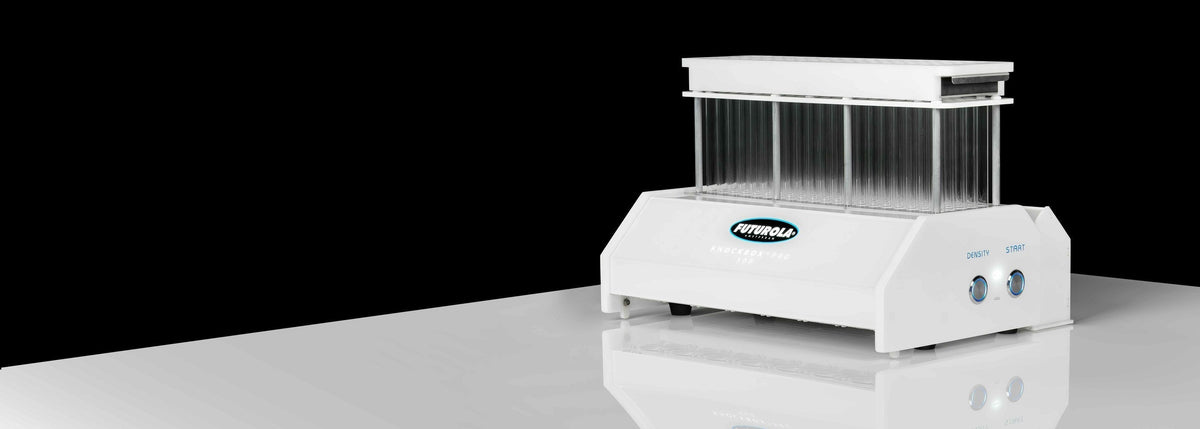
The KnockBox™ 100 is the core filling system within FUTUROLA's production line, loading up to 100 pre-rolls evenly per cycle with two selectable packing density settings.
This is generally the piece of pre roll equipment for business production that has the most direct effect on daily output, since it determines how many finished units a single cycle can produce.
The Cone Loader supports this stage by keeping cone loading consistent for a flush, even fill with minimal wasted motion.
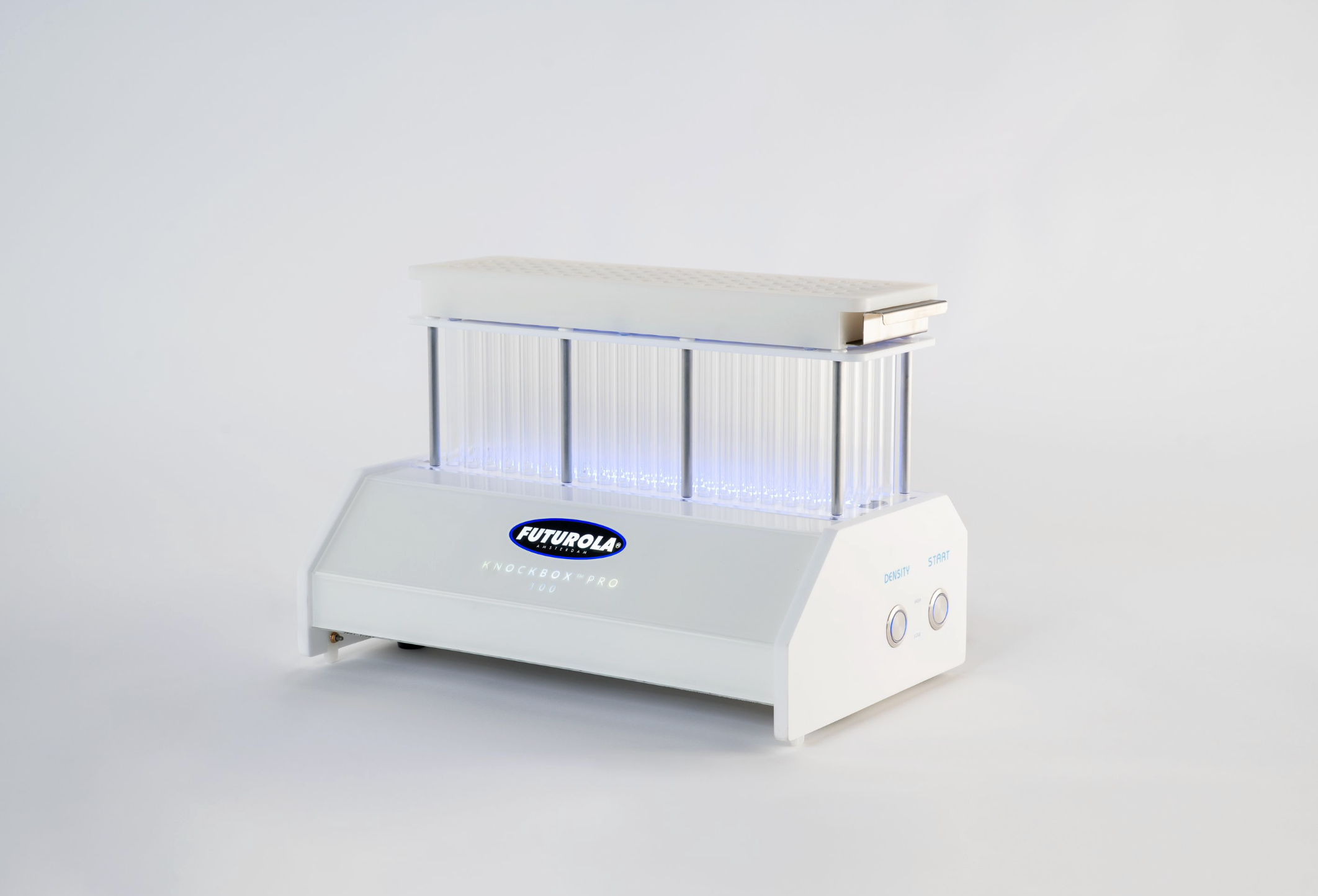
For businesses running the KnockBox™ Pro 100 instead, integrated density and start controls add a further layer of precision, letting the operator adjust fill consistency directly rather than relying on manual correction between cycles.
Closing Equipment
The Dutch Crown Device closes up to 100 cones at once using a purpose-built closing technique, available across eleven selectable cone sizes.
This stage is often the most visible to an end customer, since a properly closed cone reflects directly on finished product quality.
For a business shipping wholesale orders or stocking retail shelves, closing consistency at this stage is not optional. It is part of what differentiates best pre rolled cones finished product from something that looks rushed or uneven.
Staffing Considerations for Business-Scale Production
Equipment choice and staffing structure are closely tied together, and business production benefits from planning both at the same time rather than treating staffing as an afterthought.
A Two-Operator Model
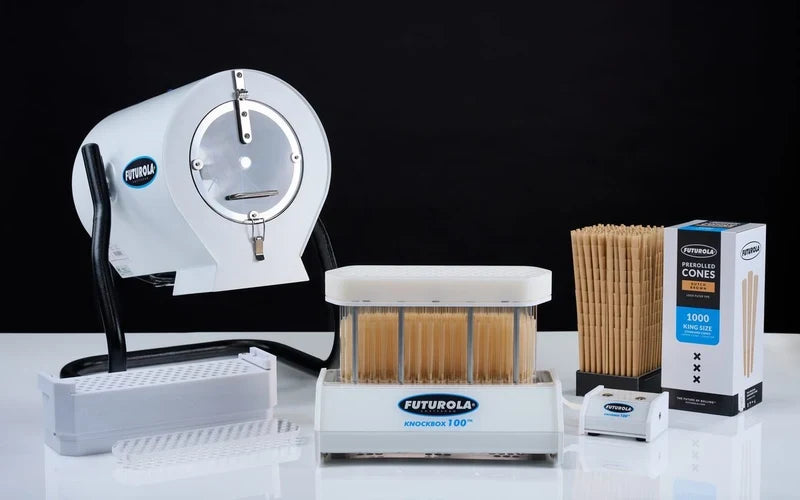
FUTUROLA's Pre-Roll Production System is built around a two-operator workflow. One operator manages the Pro Shredder, Mix Trays, and KnockBox™ 100, while the second manages the Cone Loader, Dutch Crown Device, and the reset between cycles.
This division keeps the line moving without either operator becoming a bottleneck for the other, and it means a business does not need a large crew to run meaningful daily volume.
Why Fewer, Well-Equipped Operators Outperform a Larger Manual Crew
A larger team doing manual filling and closing introduces more variation, not less, since each additional person brings their own pace and technique to the process.
Pre roll equipment for business production reduces that variation by standardizing the process itself rather than depending on individual skill level.
A well-equipped two-operator line often outproduces a much larger manual crew, while also reducing the ongoing labor cost associated with scaling output.
Matching Equipment to Business Output Goals
Selecting the right equipment starts with a clear picture of target daily output, since different configurations are built for different points on that scale.
Single Line-Up Capacity
A single two-operator line running FUTUROLA's system is designed to produce more than 20,000 pre-rolls per day.
For many businesses, that figure alone represents a significant jump over manual production methods, and it establishes a baseline that additional line-ups can build on as demand grows.
See how a single line-up fits into a full production system.
Scaling Beyond a Single Line
Businesses with higher volume requirements can add line-ups to multiply capacity:
- One line-up: 20,000+ pre-rolls per day
- Two line-ups: up to 48,000 pre-rolls per day
- Three line-ups: past 72,000 pre-rolls per day
This scaling structure means a business does not need to rebuild its production approach as it grows.
It adds a proven line-up alongside the one already running, keeping the same equipment standards and staffing model consistent across the expansion.
Two Equipment Options for Business Production
FUTUROLA offers two bundled configurations of pre roll equipment for business production, each covering the same shredding-to-closing sequence at a different point on the throughput scale.
KnockBox™ Original Bundle
The Original Bundle includes a Pro Shredder Mini, the KnockBox™ 100 filling kit in Standard, Slender, Party, or Fatboy style, a Dutch Crown Device across eleven cone sizes, and King 109/26 Standard Cones in Classic White or Dutch Brown.
Priced from $13,836 retail with $1,000 in bundle savings, this configuration suits businesses running steady, moderate production without a constant need for fine density adjustment.
KnockBox™ Pro 100 Bundle
The Pro 100 Bundle covers the same sequence but is built around the higher-cycle KnockBox™ Pro 100, adding integrated density and start controls.
It includes a Pro Shredder Mini, the KnockBox™ Pro 100, a Pro-Series Dutch Crown Device, and King 109/21 Standard Cones with a choice of FUTUROLA® Tip or Blank Tip.
Priced from $16,649 retail with the same bundle savings, this option fits businesses already running high cycle counts that need tighter, more direct control over fill density.
Planning Equipment Around Long-Term Business Growth
Choosing pre roll equipment for business production is easier when the decision accounts for where a business expects to be in a year or two, not just its current order volume.
Avoiding a Mid-Growth Equipment Overhaul
A business that outgrows its equipment mid-cycle faces a difficult choice: slow down fulfillment or scramble to add capacity under pressure.
Starting with equipment built around a scalable, six-step production sequence avoids that scenario, since additional line-ups can be added using the same proven configuration rather than sourcing entirely new equipment under a deadline.
Getting a System Specced to Actual Needs
Every business has a different combination of order volume, floor space, and staffing capacity, and equipment decisions work best when they account for all three together rather than focusing on price alone.
Anyone weighing these factors can get a system built around their specific production goals.
Talk to the team about specing a business production line.
Final Thoughts
Business production runs on different requirements than casual, small-batch rolling, and the equipment behind it needs to reflect that from day one.
Consistency, staffing efficiency, and scalable output all depend on choosing equipment built for repeatable, high-volume use rather than occasional production.
Between the Original Bundle and the Pro 100 Bundle, the right choice comes down to current volume and how much direct control over density a given operation actually needs.
Either way, starting with matched pre roll equipment for business production sets up a line that can grow without needing to be rebuilt from scratch later.
FAQs
What makes pre roll equipment for business production different from equipment for casual use?
Business production requires equipment that holds consistency across long, repeated cycles, since fill and closing variation becomes a quality control issue at higher volume.
How many operators are needed to run a business production line?
FUTUROLA's system is built around a two-operator workflow, with one managing shredding and filling and the second managing cone loading and closing.
How much output can a single production line handle?
A single two-operator line is designed to produce more than 20,000 pre-rolls per day, with additional line-ups multiplying that capacity further.
Which bundle fits a growing business best?
The Original Bundle suits steady, moderate production volume, while the Pro 100 Bundle fits businesses running higher cycle counts that need tighter density control.
Can a business scale up equipment without replacing what it already has?
Yes. Additional line-ups can be added alongside an existing setup, allowing a business to multiply output using the same proven equipment configuration.

LEAVE A COMMENT
All comments are moderated before being published.
This site is protected by hCaptcha and the hCaptcha Privacy Policy and Terms of Service apply.