
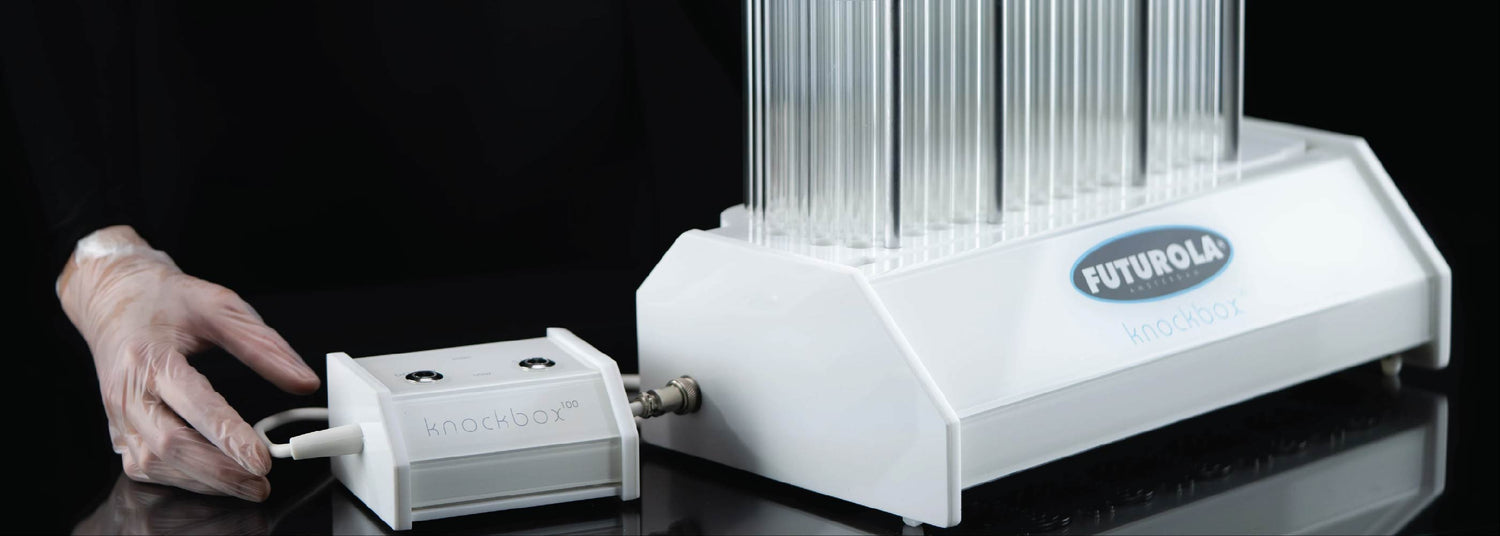
If you've ever hand-rolled dozens of pre-rolls during a busy shift, you already know how quickly fatigue, inconsistency, and wasted material can creep in. A Knockbox might be the piece of equipment you didn't know you were missing.
Originally a staple behind espresso bars, the Knockbox has found a natural home in pre-roll production, and for good reason. Whether you're running a retail operation, a production facility, or simply scaling up your workflow, this simple tool can make a measurable difference in how fast you work and how uniform your final product looks.
In this guide, we'll break down exactly how a Knockbox for pre-rolls improves speed and consistency, what to look for when choosing one, and the best methods for working it into your routine.
What Is a Knockbox for Pre Rolls?
A Knockbox for pre rolls is a filling tool used to pack flower into pre-rolled cones by tapping or vibrating the cone against a surface or platform.
The motion causes the flower inside to settle downward, compacting it evenly without the need for manual tamping.
How a Knockbox Differs from Packing by Hand
Hand packing relies entirely on the skill and feel of the person doing it. The pressure applied, the angle of the tamp, and the amount of flower added each time are all variables that shift from one cone to the next. A Knockbox removes most of those variables. The tapping or vibration mechanism is consistent, meaning the flower settles the same way each time. It delivers even, predictable, and faster fills than anything achieved by hand alone.
Why Speed Matters When Filling Pre-Rolls at Volume
For anyone filling cones in large quantities, time is a genuine constraint. Hand packing each cone individually creates a bottleneck that slows down the entire production process, but a Knockbox addresses that bottleneck directly.
How It Cuts Down Filling Time
The tapping or vibration action of a Knockbox settles flower faster than manual tamping. Instead of pressing down in stages and checking the fill level repeatedly, the operator loads the cone, taps it against the Knockbox, and the flower compacts on its own.
This process takes seconds per cone rather than the longer back-and-forth that hand packing requires. During an entire production run, the time you end up saving is significant.
How a Knockbox for Pre Rolls Improves Consistency
Speed matters, but consistency is the reason most large scale rollers make the switch to a cone packing machine.
A cone that works well is a cone that is packed well, and packing well by hand every single time is harder than it sounds.
This is why the filling tool is mostly used by retail shops and people who produce cones for others. Customers who receive a well-packed cone with a reliable draw are more likely to return, and a Knockbox makes that standard achievable without relying on one person’s skill or experience.
Even Distribution and Fill Density
When flower is loaded into a cone and then tapped using a Knockbox, gravity and vibration work together to distribute it evenly from the tip upward. There are no air pockets, no uneven clumps, and no sections that are packed tighter than others. The fill density stays consistent across every unit in the batch.
What to Look for in a Quality Knockbox
Not every Knockbox is built the same way. Before you buy, check if the tool you’re getting is the best one for you. Some of the things you should consider are
Size and Cone Compatibility
Cone sizes vary, and a Knockbox that works well with king size cones may not be ideal for 1¼ or 98 mm cones. Before committing to a purchase, confirm that the Knockbox is compatible with the specific cone sizes you use. Although some models are built for one format, while others can accommodate multiple sizes.
Build Material and Durability
Knockboxes for pre rolls are commonly made from wood, acrylic, or a combination of both. Wood absorbs impact well and holds up over extended use but requires more care to keep clean. Acrylic is easy to clean and gives a view of the cone during the fill process, although it could easily crack under heavy use. The right material depends on how frequently the Knockbox will be used and the environment it's kept in.
Vibration vs. Manual Knock Mechanisms
Manual knock models require the operator to tap the cone against a padded surface, while vibration-based Knockboxes use a motor to produce a continuous settling motion.
Manual models are simpler and require no power source, making them a good fit for smaller operations.
Vibration models tend to produce a more uniform result and are better suited for mass production settings where speed and repeatability are the priority.
Knockboxes for Pre-Rolls vs. Other Filling Methods
A Knockbox for pre rolls is a strong option for many setups, but it's not the only cone packing machine available.
Understanding what it can do compared to other methods is what determines if it's the right choice for your operation.
When a Knockbox Is the Right Tool
A Knockbox is well-suited for small to mid-volume operations where quality control matters and production is done one cone at a time or in small batches. It offers more precision than hand packing while keeping the process simple and accessible. For rollers who value control over the final product without the complexity of a filling machine, a Knockbox is the practical middle ground.
When You Might Need Something More
Large operations that are filling hundreds of cones per session will see that using a single Knockbox is a limiting factor. At that scale, multi-cone filling machines designed for large production runs become a more practical choice.
A Knockbox is an excellent starting point, but it's worth knowing that the tool can be outgrown as volume increases.
Final Thoughts
A Knockbox is one of those tools that makes an immediate, measurable difference. The fill is more even, the process is faster, and the end result is more consistent than hand packing. For anyone who fills cones regularly, whether for personal use or at a shop level, it's a worthwhile addition to the setup.
When choosing a Knockbox for pre rolls, focus on cone compatibility, build quality, and whether the mechanism matches the volume of your operation. Those three factors will point you toward the right tool for where you are now, with room to scale when the time comes.
FAQs
What does a Knockbox actually do?
A Knockbox is a tool that uses tapping or vibration to settle flower evenly inside a pre-rolled cone. The motion compacts the flower from the bottom up without the need for manual tamping. This results in a more uniform fill density and a cleaner end product.
Who is a Knockbox for pre rolls best suited for?
A Knockbox for pre rolls is a strong fit for frequent rollers, retail shops, and anyone producing cones in moderate to large volume. It's especially useful for operations where consistency matters and hand packing is no longer producing reliable results across the batch.
Are all knock boxes compatible with every cone size?
Not always. Some Knockboxes are designed for a specific cone format, such as king size or 1 ¼, while others are built to accommodate multiple sizes. Always check the product specifications before buying to confirm compatibility with the cone sizes you use most.
How do you clean and maintain a Knockbox for pre rolls?
Cleaning a Knockbox depends on the material. Acrylic models can generally be wiped down with a dry or lightly damp cloth. Wooden models benefit from occasional dry brushing to remove residue and should be kept away from moisture to prevent warping. Regular cleaning keeps the tool performing well and extends its lifespan.
How does a Knockbox for pre rolls compare to filling cones by hand?
Hand packing is slower and harder to replicate consistently. A Knockbox for pre rolls removes much of the guesswork by using a repeatable mechanical action to settle flower evenly. The result is a more uniform fill in less time, with less reliance on individual technique.


LEAVE A COMMENT
All comments are moderated before being published.
This site is protected by hCaptcha and the hCaptcha Privacy Policy and Terms of Service apply.